Saturday, January 12, 2019

DAYENU


This summer I will reach an important milestone on my Jewish journey when I’m called to the Torah as an “adult” bat mitzvah (daughter of the Commandments.)  When the Rabbi opens the sacred scroll, I will take out my yad (pointer) and read my portion in leshon hakadosh (the holy language) then celebrate with family and friends at a simcha (party). But before anyone says Mazel Tov (congratulations), I still need to learn Hebrew.


Learning a new language can be thrilling, romantic, and life-changing. Like Eat, Pray, Love. Or those Rosetta Stone ads with the Italian supermodel and the hard working farm boy. When I was 19, I spent a summer in Paris studying French. By "studying" I mean flirting with Xavier, a gorgeous garçon from a Left Bank cafe who didn’t speak English.


He was a hardworking waiter.
She was an American college student.  
She knew she would have just one chance to impress him.
L’escargots s’il vous plait!

I met him on my first day and, needless to say, I was fluent in French by the end of the summer.

But now I’m not learning a new language - I’m learning an old language, the oldest in continuous use.  And I’m old. This reality set in when I arrived at my first lesson, a “Hebrew Marathon," held in a windowless room in the basement of the Jewish Community Center.

She was a menopausal mom in yoga pants and Ugg boots.
He was a septuagenarian synagogue volunteer with coffee breath and ear hair.
He knew he would have just 8 hours to teach her the Hebrew alphabet.
And she forgot her reading glasses.
Oy vey!


My instructor, Saul, was an incredibly patient man. He spent the entire day taking us through the workbook, page by page, letter by letter, sound by sound. Amazingly, by the end of the class, I was able to sound out words and prayers. I was reading Hebrew!


“But you must promise that you’ll practice, dear Patty,” he said. “Everyday. And everywhere. Or you’ll lose it as quickly as you learned it.”  

I promised and now I carry my Hebrew alphabet flashcards (ages 3+) with me at all times, reviewing them in the checkout line at Trader Joe’s, at the nail salon and on the crosstown bus. I sing along with Shalom Sesame (Israeli Sesame Street) while walking the dog. I sit on the subway watching Jonathan Ginsberg, the “YouTube Rabbi” who leads a congregation in Skokie, Illinois and offers online Hebrew instruction.

It's going to take a village to get me to the Torah and I’ll take all the help I can get.

Recently, as I was making my way through my homework - a full page on the vowels and the “nun” which sounds like “n,” I found myself sounding out several words: elu natan natan lanu, natan lanu et ha torah. I recognized the words from a song in the Passover haggadah - Dayenu - a song of gratitude for all the gifts God gave to the Jewish people. Literally translated, Dayenu means “it would have been enough.” I thought about all of the gifts I have been given. It would have been enough to convert to Judaism and to have a Jewish wedding. It would have been enough to build a Jewish home and host so many happy holidays over the years. It would have been enough to see my beautiful daughters read from the Torah when they became b’not mitzvah in 2012. And now I’m being given yet another gift - the opportunity to learn this ancient language for the sole purpose of reading from the Torah. It’s an awesome responsibility and an incredible privilege. I’m grateful to become a bat mitzvah. I’m grateful to become an adult.


Friday, February 2, 2018

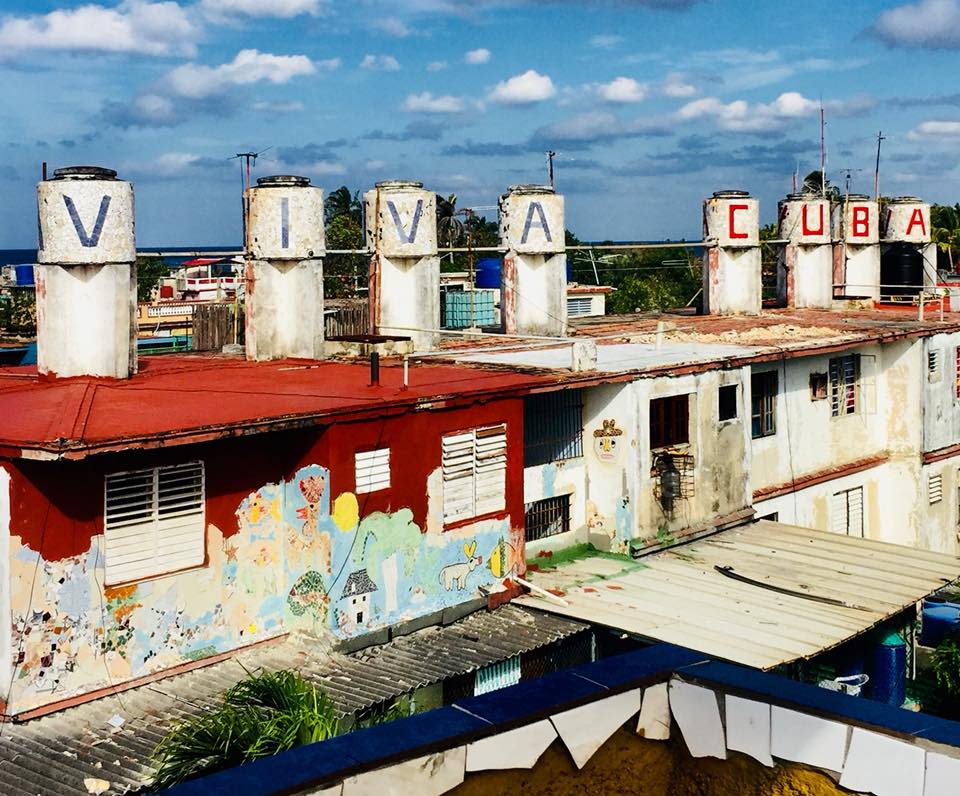
Viva Cuba!


Two hours into the bus ride from Havana to the Valle de Viñales, I found myself unconsciously humming the theme from “Land of the Lost,” the ‘70s Saturday morning TV show about a family whose raft goes over a waterfall and deposits them into a prehistoric alternate world. Along the autopista, farmers wearing wide-brimmed straw hats and chomping on cigars work tobacco fields with yoked oxen and mules instead of tractors and trucks. Enormous limestone flat-topped hills, mogotes, which date back to the Jurassic period, rise up from the valley floor surrounding us like ancient creatures (one formation looked just like a giant elephant.)  Goats, sheep, cows and chickens wander along the side of the road as a horse-drawn carriage hugs the shoulder. On the horizon, the dark gray asphalt, punctuated by candy-colored cars from another century, cuts a swath through the lush green landscape. There are no billboards. No rest stops. No Wifi. No cell service. No traffic. No commerce. “We are really off the grid,” I thought as our bus pulled into our lunch spot - a small wooden house with a thatched roof tucked beneath one of the giant domes. This was the starting point for the Backroads Cuba Biking Tour - a five-day trip which would take us from the Valle de Viñales, a UNESCO World Heritage site, back to Havana - 160 miles of spectacular scenery, local culture and off-the-beaten-path biking.
Ever since the Obamas’ glamorous and historic visit in 2016, I’d been dying to go to Cuba to explore the cobblestone streets of Old Havana, sip Café Cubano while smoking a hand-rolled Cuban cigar, drive on the Malecón in a convertible ‘57 Chevy, and eat fresh fish and frijoles negros on a white-sand beach while listening to live salsa music. I assumed my dream would be deferred for another four years since President Trump issued new regulations restricting individual travel to Cuba. Then Backroads invited me and a group of other writers to preview its new People-to-People Biking Tour, the first trip of its kind from a US active travel company.
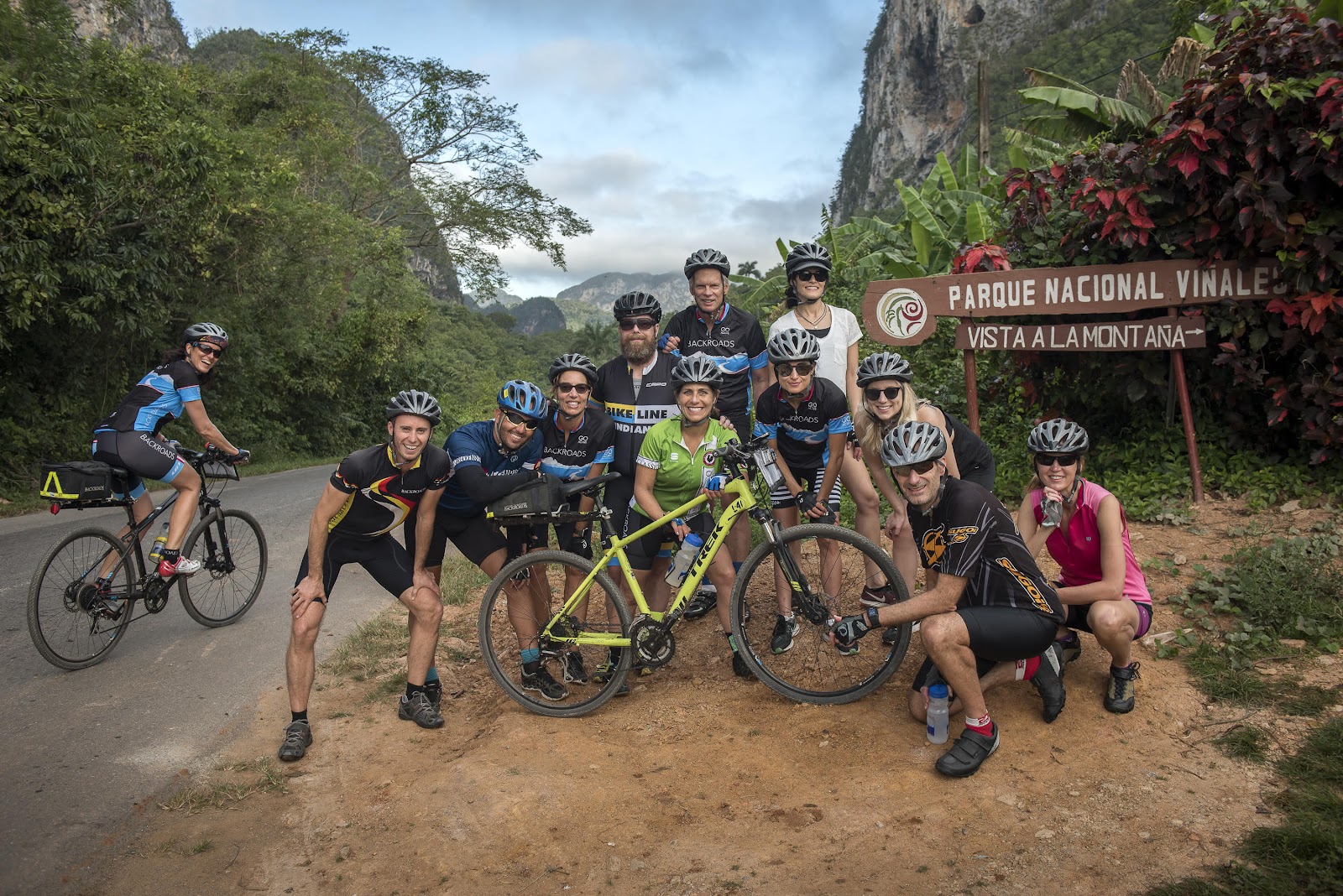
That's me, third from the left with our group + guides who were road-testing the Backroads Cuba Biking Tour


While I was a bit apprehensive about biking 25-40 miles per day along the island’s rugged roads (my achy middle-aged knees had spent the last 10 weeks in physical therapy and my Cuban vacation fantasy involved floral dresses and flip flops more than padded bike shorts and potholes), I had to say yes to this amazing opportunity.
And I’m so glad I did! The tour expanded my limited postcard vision of Cuba by taking me to stunningly unspoiled beaches and biospheres, nature reserves and national parks. It also gave me a feeling of freedom and independence I haven’t felt since my mid 20s. For a quarter of a century I’ve been following my husband through airports, or packing snacks for the kids, or carrying everyone’s passports or making the reservations and planning the itineraries. This was the first trip in decades where I wasn’t someone’s wife, mother, caretaker, organizer.  And without cell phone service or WiFi, nobody could reach me...which was a nice break. I had a taste of midlife freedom and, no offense kids, bring on the empty nest!  


Soaking up the sun and checking out the scenery
The trip also invited me to challenge myself physically in a way that I hadn’t since I turned 50 (I ran a half marathon when I was 48 but I injured my knee and hadn’t done much strenuous exercise since.) Much of the cycling felt like mountain biking with stretches of rough pavement (I’m glad I packed cycling gloves!) and a few of the routes included serious inclines like our 35-mile ride on day four. It started out with a long uphill climb and it was steep. So steep. Soooooo steep. I had been bringing up the rear all week or hopping on the support bus when I got tired, but that day I was feeling strong and was determined to crush that hill. I engaged my core and pushed and pushed and sweated and pushed. I might have even cried a little but I rode past Brian, a super fit travel writer who heli-skis and white-water kayaks for fun. I rode past the Soul Cycle-sassy millennials who actually look good in bike shorts because their butts are so small. As if giving birth to my beautiful children I pushed through the pain. And it hurt. A lot. Nevertheless I persisted.  I made it to the top and everyone cheered as I screamed in agony and then belted out the theme from ROCKY.  
Nevertheless, I persisted! 
As awesome as these experiences were, the true beauty of the trip was the personal and frequent interactions with Cubans. From organic farmers and chefs to doctors and artists; teachers and school kids to salsa dancers and cyclists, the locals welcomed us into their homes and business with pride, passion and positivity. I was deeply moved by the pervasive feeling of happiness and contentment among the locals (at least the ones we met) who survive on extremely limited resources, meager salaries, food rations, government restrictions and very modest housing. There’s no doubt Cubans still have some big hills to climb. But their indomitable spirit will surely carry them to the summit. Viva Cuba!


Day One of our ride after lunch at a paladar beneath a mogote

BIKE, SLEEP, EAT, REPEAT

The Backroads Cuba Biking Tour covers 160 miles in the northwestern region of the island including Viñales National Park, La Güira National Park, Cayo Jutias, the Sierra del Rosario Biosphere Reserve, and Fusterlandia. Here are some of the places we ate, slept and visited:

Valle de Viñales


Sleep:  Located high upon a hill, Hotel Los Jazmines offers spectacular views of the mogotes. But this wilting pink flower is in need of a makeover. The rooms had a slightly seedy ‘70s motel vibe (sanitation strips over the toilet, thin bedspreads and towels, earth tones) and there was no running water for 24 hours during our stay (we had to change rooms) All was forgiven, however, when I opened the shutters, stepped out onto the terrace and took in the breathtaking beauty of the Valle de Viñales.     
Room with a view at Hotel Los Jazmines.


Eat:  After touring Finca Agroecologica El Paraiso, a gorgeous organic farm, and visiting with the animals (bunnies, baby goats, sheep, pigs, chickens), we picked vegetables for our salads and enjoyed a traditional (and delicious!) Cuban meal - pork, chicken, fish, rice, beans, vegetables and flan.
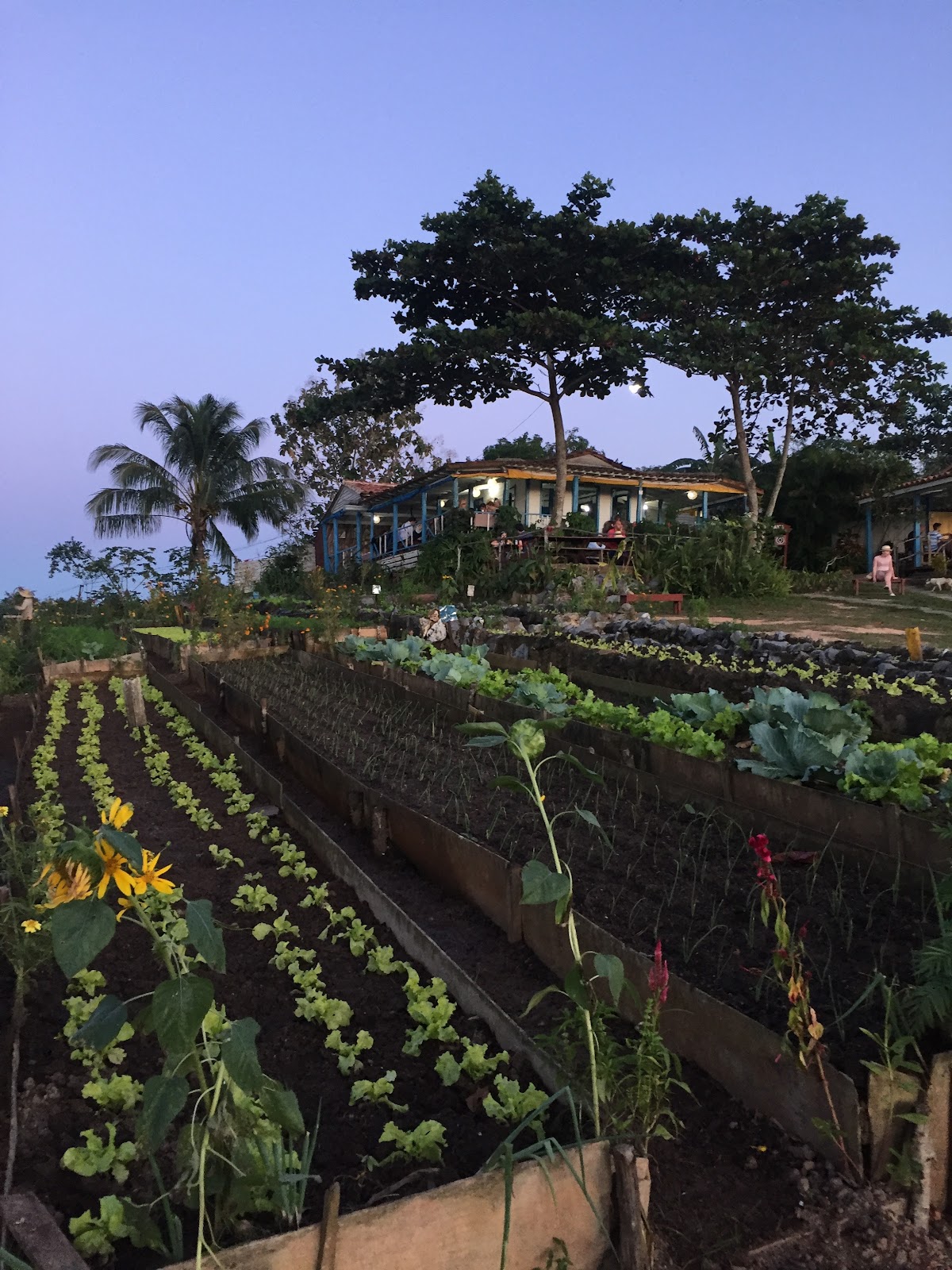

 Finca Agroecologica El Paraiso


 Finca Agroecologica El Paraiso

Sierra del Rosario Biosphere Reserve
Sleep:  Perched atop the sustainable eco-village, Las Terrazas, Hotel Moka blends into the surrounding natural beauty.  A large carob tree grows in the middle of the lobby - guests are encouraged to touch it for good energy.  The rooms are spacious with terra cotta tile floors, modern bathrooms, cable TV and large terraces.  With good WiFi, the open air lobby is a fun hangout for guests who can enjoy live music from the upstairs bar while checking their Instagram feed.


Eat/Shop: Part ashram, part kibbutz, part ‘60s commune, Las Terrazas houses one thousand people who live for free and contribute to the community.  Nobody locks doors or windows and young kids roam freely around the property with seemingly minimal or no adult supervision. There are several restaurants, two coffee shops, a disco, a school, a museum, a doctor’s office and pharmacy, a playground and even a zip line. We ate dinner at two of the excellent restaurants, scored some beautiful handmade souvenirs from local artisans at the gift shop and enjoyed an afternoon Café Cubano .


The view from my room at Hotel Moka overlooking the community of Las Terrazas
Enjoying a cuban coffee with my fellow travelers at Las Terrazas
Last stop, Havana!


I loved this city so much!!!


Sleep:  The night before I met up with the Backroads group, I was on my own and chose to stay at Casa Compostela, a “Casa Particular.” Not gonna lie, I was a little nervous when my taxi arrived and there was no sign and no formal entrance - I had to carry my bag up a steep staircase while a pit bull barked behind a cage under the stairs. But..for $80, I had a spare but clean room with a small terrace and a bathroom in a private home in the heart of Old Havana. I was steps away from great shopping, food and sights - and if I wandered too far, there were loads of pedicabs (about $5 to get around Old Havana.) For $30 extra, Casa Compostela arranged to have a taxi driver meet me at the airport upon my arrival (which was helpful since I was traveling alone and I do not speak a word of Spanish.)


Sleep: On the last night of the trip and on the opposite end of the lodging spectrum, we stayed at Gran Hotel Manzana Kempinski La Habana, the city’s first true luxury hotel located next to Parque Central and the famous El Floridita. The hotel is in a stunningly restored building from the 1800s and is very chic and modern with an infinity pool overlooking the city. It felt a little strange to stay in such overwhelming opulence after traveling through the countryside and seeing how modestly the Cubans live. But it's beautiful, comfortable and in a perfect location. Even if you don’t stay here, it’s worth a visit to the rooftop bar for a sunset mojito.

The scene on the Gran Hotel Manzana Kempinski rooftop
Eat:  Although Cuba is not known as a foodie destination and fresh ingredients can be very limited, we had terrific meals at 304 O’Reilly - tiny taco and empanadillos, local artwork on the walls, delicious and huge non-alcoholic cucumber lemonade; Chef Ivan Justo - big portions, fresh fish, fun vibe in an old house with Hollywood memorabilia including an entire wall devoted to Marilyn Monroe photos;  El Cocinero - hey, if it’s good enough for Michelle Obama who ate here when she visited Havana; Fabrica del Arte, a massive warehouse space with several bars, art installations, interactive exhibits, live music, boutiques, film and cafes - a must-visit; El Dandy - the cutest little coffee house serving light fare and displaying photography by young Cuban artists; Sia Kara - super hip piano bar and cafe in an alley behind the capitol building with dancing and singing waiters and fabulous frozen lemonade (with or without rum). We arrived at 1am and it was still hopping
The piano where the magic happens at Sia Kara

Shop: A boutique that would feel at home in Brooklyn, Clandestina sells trendy recycled t-shirts and totes with tongue-in-cheek phrases and youthful designs. Cubans can also bring in their own t-shirts and get them silk-screened at Clandestina.


On the other side of Old Havana, Piscolabis offers a fantastic collection of paintings, pillows, jewelry and furnishings from local artisans and small but very stylish selection of modern linen guayaberas for both men and women.


Piscolabis, Havana  

Piscolabis, Havana
Mural in Old Havana
Art: On the final day of the trip, we visited Fusterlandia, 
a formerly impoverished neighborhood reclaby Cuban artist José Fuster. 
Whimsical, colorful, magical, wonderful!

Fusterlandia


For more information on the rules and restrictions regarding travel to Cuba 
visit the US State Department website 
and for a detailed itinerary of the 
People-to-People Cuba biking tour, visit Backroads.com .


Tuesday, November 7, 2017

Tennis, anyone?

Last week, my youngest daughter applied to college. In nine months she will move out of the room she's inhabited since birth and we will be empty nesters.

David and I have been anticipating this moment for years and spent a lot of time this summer anxiously (and excitedly) wondering what we're going to do with ourselves. Or more importantly, what we're going to do together. David doesn't ski and I don't play golf; he likes crossword puzzles, I like yoga. I suggested a salsa class, he said maybe we should get another dog.

One day in September I went out for a bike ride along the Hudson River and, as I passed by the beautiful clay tennis courts on 97th Street, I had my Eureka moment.

Tennis! I should learn to play tennis! 

David loves tennis and is very good at it. He was on his high school team (state champions!) and plays as often as he can. He's always looking for a partner.

I haven't played much since 1986 when I took a tennis PE class in college. The teacher was a tall, blond, preppy surfer named Brad (or Kip or Ted or Chip) and I was way more focused on what my hair looked like than how to hold a racquet. I was so awkward around him that every time I missed the ball or hit a bad shot - which was most of the time - I dissolved into nervous laughter and endless apologies. I decided I was terrible at tennis and gave it up.

Until now.

"Do you offer any classes for slightly out-of-shape middle-aged ladies who are looking for a healthy hobby?" I asked the pro at the Riverside Clay Tennis Association office.

"Absolutely," he said with a chuckle. "You can register online and I suggest you take a few lessons with Froi Silva. He'll get your blood pumping." Visions of Rafa Nadal danced in my head.  I raced home, logged on and booked 6 sessions.

A couple days later, I returned, suited up (more Chris Evert than Serena Williams) and ready to play. The pro walked me onto the court to meet Froi. Like Nadal, he was tan, toned, fit and ready.  Unlike Nadal, he was about 75 years old.  Given my experience with Brad (or Kip or Ted or Chip) I was relieved. I didn't need the distraction. I just wanted to play tennis.

Froi began the lesson by hitting what felt like 100 balls to me in rapid succession. Ten minutes into the one-hour class, I felt dizzy, drenched and defeated. Sensing my distress, Froi called me to the net.

"Patty, what I'm seeing is this," he said as he flapped his arms around like a dancing balloon man. "I need to see this," he said demonstrating a smooth, graceful forehand stroke.  "Not this," he said waving his racquet around again.

I think my tennis teacher just called me a spaz, I thought. "Spaz" was my unfortunate nickname in high school and I've always been self conscious about my long, skinny, flailing arms. I felt a wave of embarrassment, thinking back on my classes with the preppy surfer boy and the shame of feeling so uncoordinated on the court.

But instead of the giggly apology of 30 years ago, I listened. I focused. I got back into position, took a few deep breaths and hit some pretty good shots.

During each lesson, I got a little better. I wasn't as tired. I had more power. My form improved. And I loved that for one hour, I was completely present, thinking only about getting that ball over the net. Even at yoga class I can lose focus and start thinking about my to-do list during shavasana. But not on the court. Tennis had my full and undivided attention. And it was truly invigorating.

At our final class, Froi and I enjoyed a long rally where I was completely in the zone, hitting back and forth, back and forth in a steady rhythm. I felt like a real tennis player.  At the end, Froi met me at the net.

"That was better than good," he said. "That was very good."

I nearly cried.  For 30 years I've told myself - and anyone who ever asked me to play - that I'm bad at tennis, that I have hand-eye coordination challenges, that I'm a "spaz" or, less politely, that I suck. Now I was "better than good." And it felt good!

Not long after, David and I spent the weekend with friends who have a tennis court. For the first time in our 25 years together, we played as a mixed doubles team. And we won.

Friday, October 27, 2017

Radical Acceptance

Next week I'm turning 52 and I'm having a hard time wrapping my head around the idea that I'm "a woman in her early 50s." I don't have much gray hair, my menses hasn't paused and I still sunbathe like a teenager. I could probably pass for 42. But I'm not 42. I'm a fiftysomething. A quinguagenarian. Une femme d'un certain âge.

I thought turning 50 would be the catalyst for a full-blown midlife meltdown. But I was so busy planning a birthday trip to Brazil and starting a new job that I didn't have time for much self reflection. Or self pity. Also, our nest was still full and, except for my doctor telling me I had to get a colonoscopy, 50 just felt like another number.

But now I have one daughter in college and another applying this fall. They're getting ready to fly. I'm lowering my landing gear. They're on the runway preparing for takeoff while I'm beginning my descent. Instead of asking myself, What do I want to be when I grow up? I've started wondering, What do I want to do before I die? I used to have a wish list - run the NY Marathon, drive a convertible Mini Cooper, visit all seven continents, etc. Now I refer to it as my bucket list. It's subtle. But it's a definite shift.

Does this qualify as a midlife crisis? Maybe. But I prefer to think of it as middle-age clarity - the realization that this is not a dress rehearsal, that this is, as poet Mary Oliver writes, my "one wild and precious life." How am I going to spend my time left? What am I going to do with all the gifts I've been given? If I can keep the gratitude in my attitude, it's not terrifying or depressing at all; it's actually liberating and exhilarating. Instead of navigating the class 5 rapids of marriage, career and kids; of date nights and business trips and soccer schedules and appointments; of pre-school, after-school, middle school and high school; of part-time, flex-time, full-time and overtime; of summer camp and specialists and babysitters and nannies; of brown bag lunches, healthy snacks, and home-cooked dinners; of not only trying to have it all but do it all, like it all, and be good at it all; instead of holding my breath, I can exhale and float on calm waters knowing I made it through the big waves - not perfectly, not always gracefully, but at least upright.

My birthday wish is to slow those feelings of anxiety about the future and regrets about the past and stay rooted in the present, fully accepting that every choice, every job, every decision, every mistake got me to this place. 

And it's exactly where I'm supposed to be.


Saturday, June 21, 2014

The Empty Nest

Nearly every morning, in every season, David and I walk the dog. It's our favorite 30 minutes of the day, that sacred sliver of uninterrupted time after the kids have gone to school and before the demands  of work, errands, projects and chores pull us in opposite directions.

Under sunny skies or on snow-packed sidewalks, our route is always the same. Gus leads the way down our block on West 104th Street, across Riverside Drive and then down the stairs into Riverside Park. We take Gus off the leash for the half-mile loop on the promenade along the West Side Highway, around the playground at 97th Street and then back through a wooded area of the park (so we can feel like we're in nature.)

One spring morning, beneath the pink pompoms of a blossoming cherry tree, we noticed a man pointing toward a branch. Curious, we followed his finger until we could see a perfect robin's nest. As we looked on, a female robin approached and we were amazed to see three little beaks peek up over the top of the nest, opening excitedly as they waited for their breakfast.


"Just like when we come home from a big shopping trip at Fairway," I joked.

The robin's nest became a must-see on our morning walk. We would always stop and look for their beaks or feathers to make sure that the baby birds were okay. One day, as the petals covered the ground and the leaves turned to bright green, we saw that one of the baby birds had gotten out of the nest and was perched on the tree branch as the mommy robin watched from a nearby ledge. 

"It's like the first time Mara took the subway alone," David said. 

Days later, we saw two robins out of their nest and no sign of the mom.  

"It just feels too soon," I said as we kept walking. 

The following day, a heavy rain interrupted our usual walk. But when the skies cleared in the afternoon, I took Gus out to get some exercise...and to check on the birds.  When we reached the tree, I spotted the nest. All was quiet as I approached the branch. I stood on my tip toes to peek inside.  It was empty. All three baby robins were on their way.


Gus and I continued our walk, past the Dinosaur Playground where Mara and Lily had spent countless hours swinging and sliding and playing in the sprinklers. We walked past the soccer fields where David had coached the girls' teams and then along the promenade where they had learned to ride bikes. We passed by the Swing-a-Ring area where they hung and flipped and perfected their tandem swing. We crossed over the lawn where we used to play catch and practice softball and lacrosse. By the time we reached the Tot Lot, across from our apartment, I was a bit misty-eyed.

In just two years, one of our birds will be leaving the nest when she heads off to college. In four years, the nest will be empty. Granted, with their social lives and sports teams and school activities, Mara and Lily are not around as much these days. And when they are, they're often behind closed doors or under headphones or in front of a screen. But they're home. At least for a few more years.

Which brings me to my adult bat mitzvah.

The ceremony was scheduled for the fall of 2015 - right around my 50th birthday - so I was thrilled to usher in this milestone in meaningful way (and to have a built-in theme for my party!) When I embarked on this leg of my spiritual journey seven months ago, my goal was to study Hebrew, read from the Torah and, like the rest of my immediate family members, become a Jewish adult. Because we'd now have the shared experience of this Jewish rite of passage, I sincerely hoped that my becoming an adult bat mitzvah would bring the family closer together.

But our family synagogue, Ansche Chesed, doesn't offer an adult bat mitzvah program (yet) so I enrolled in a course at Romemu, a Renewal Judaism congregation. In order to participate, I had to become a member. So I belong to two synagogues - one with the family and one on my own. As part of the class, I was encouraged to attend Friday night and Saturday morning services. I enjoy the music and the spirituality at Romemu and thought the family might like it too. They did not. So I was going to services alone or with friends while the family stayed home.  

The class met every Monday night from 6:30-9:30 (although I would leave for class at 6 and return home by about 10:15) and there was an hour-long Hebrew class on Sunday mornings. As expected, there was also quite a bit of homework, including meeting with a study partner outside of class. 

Okay, so I know it wasn't like I was moving to Israel to live on a kibbutz for two years, but it felt like a lot of time away. And after I saw that empty nest, I decided that I really want to pursue activities that keep me closer to the home. So I made the decision to withdraw from the class and postpone becoming an adult bat mitzvah...for now. 

During my seven months of study, I met some incredible, inspirational people. I learned to read Hebrew (although I need to keep practicing!) I wrote a midrash on the Binding of Isaac that will be published in the 2014 Jewish Women's Literary Annual. And I created my own Haggadah and hosted a Passover Seder which was a big hit among our guests who ranged in age from 4 to 79. I launched this 'blog and plan to keep writing about my coming of [middle] age experiences. And I will try to make sure my spiritual practice fits into the family flow instead of trying to fight the current. 

Meanwhile, any 50th birthday party theme suggestions are welcome.